
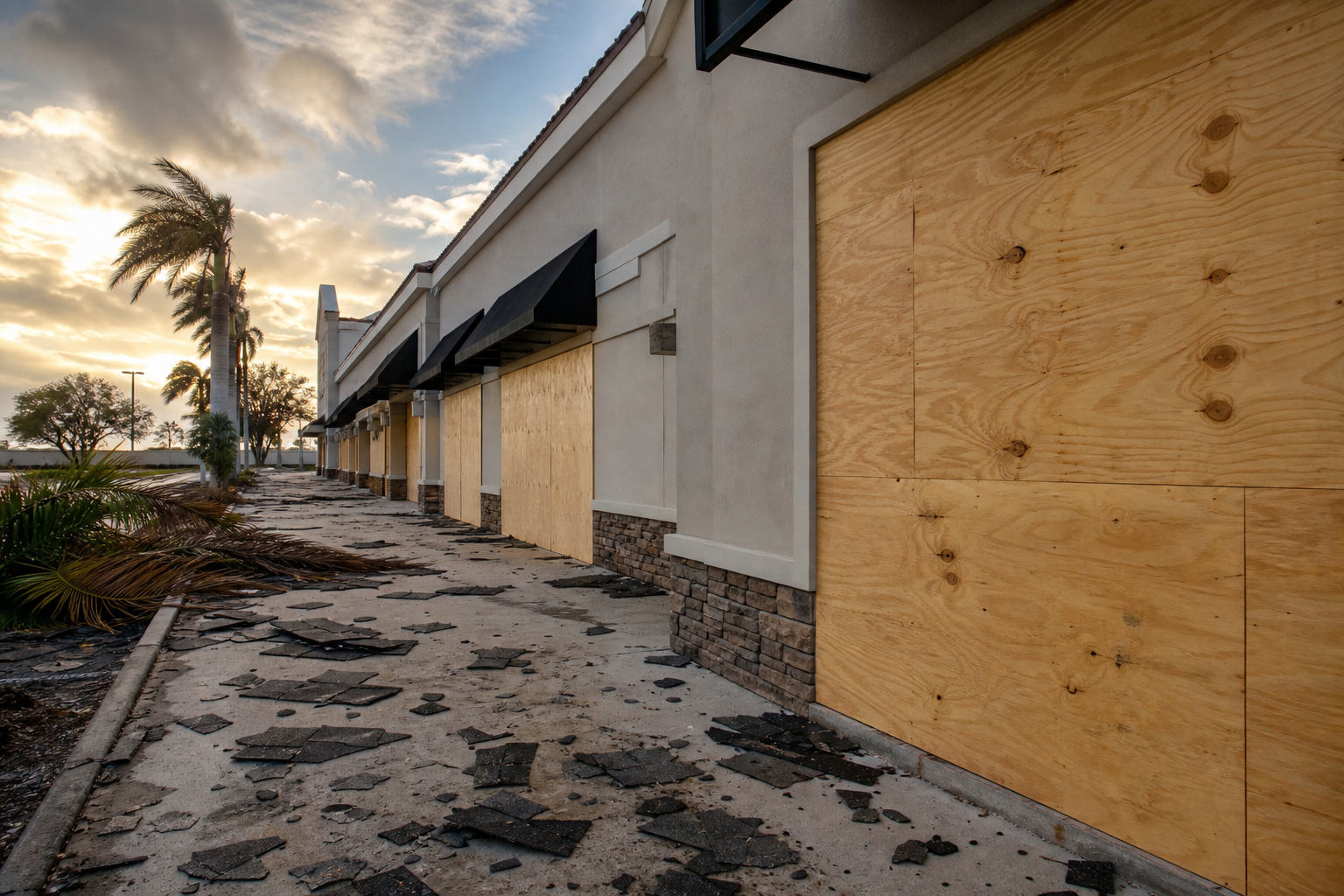
Commercial Storm Damage Restoration
A 40-year operator's guide to large-scale recovery, insurance coordination, and structural stabilization.
Built for asset managers, property managers, and risk teams responsible for keeping commercial buildings open after named storms, tornadoes, and severe wind events.
Why this guide exists
The checklist is the easy part. The hard part is running a $2M loss on a live building.
Most "storm damage" articles online stop at "tarp the roof and call your insurance company." That works for a single-family home. It does not work for a 280-unit garden community with displaced residents, a 200-room hotel hemorrhaging revenue per night, or a senior-living campus that cannot evacuate.
Commercial storm damage restoration is three jobs running at once: an emergency operation, an insurance negotiation, and a construction project. Property managers who treat it like a single workflow lose months of schedule and six figures of coverage. The teams who run the three tracks in parallel — from hour one — reopen faster, defend their scope, and keep their owners and carriers aligned.
This playbook is the protocol Coastal Reconstruction Group has refined over 40 years of named-storm response across Florida, Georgia, and the broader Southeast. It is built for operators, not homeowners.
The 4-Phase Playbook
From first notice of loss to reopening
Phase 1 — Emergency Stabilization (0–24 hours)
The first 24 hours decide whether a covered loss becomes a controlled restoration or a six-figure secondary-damage claim. Crews focus on life-safety, building envelope, and preventing water migration into adjacent suites, slabs, and assemblies.
- Site-safety sweep: downed power, gas leaks, structural compromise, biohazard exposure
- Emergency board-up of broken glazing, storefronts, and exterior doors
- Temporary roof tarping or shrink-wrap to halt water intrusion at the deck
- Water extraction from common areas, units, and elevator pits before it migrates to lower floors
- Generator deployment for life-safety systems, fire pumps, and refrigeration where utility power is down
- Time-stamped photo and 4K video documentation for the carrier's first notice of loss
Phase 2 — Structural Triage & Drying (Day 1–7)
Once the envelope is sealed, the work shifts to drying the structure and confirming load paths. Skipping or shortening this phase is the single biggest driver of mold claims and warranty callbacks on storm jobs.
- Engineered drying plan: psychrometric readings, moisture mapping, and equipment counts documented daily
- Selective demolition of saturated drywall, insulation, baseboards, and flooring to expose cavities
- Antimicrobial application on framing, sheathing, and substrates within the first 72 hours
- Third-party industrial hygienist (IH) clearance for Category 3 (storm/flood) water before reconstruction
- Structural engineer assessment of any sagging decks, displaced trusses, or wind-loaded shear walls
- Daily dry logs released to the carrier and property manager — required to defend the scope at closeout
Phase 3 — Scope, Estimate & Carrier Alignment (Week 1–3)
Most storm-loss disputes are won or lost in the scope. CRG writes Xactimate-compliant estimates that line up to the adjuster's platform on the first pass, then defends every line with field documentation.
- Xactimate estimate written in the carrier's preferred price list, ZIP-coded to the loss
- Side-by-side scope reconciliation with the carrier-assigned adjuster and any independent or public adjuster
- Code-upgrade documentation (IBC, IECC, ADA) where current code triggers ordinance-or-law coverage
- Supplements drafted with photo evidence, IH reports, and engineer letters — not just line-item adds
- Owner-facing summary that translates the carrier estimate into plain English for asset managers and boards
Phase 4 — Reconstruction & Reopening (Week 2–16+)
Self-performed reconstruction is the difference between a 12-week and a 26-week schedule. CRG keeps framing, drywall, paint, flooring, and final clean in-house so the schedule does not stall waiting on subs.
- Permit pull and inspections coordinated with the AHJ — including emergency permits where allowed
- Self-performed framing, drywall, paint, doors, trim, flooring, and final detail
- Phased reopening plans for hotels, multifamily, and senior living so revenue restarts before substantial completion
- Owner-direct change orders with photo backup; no surprise invoices at closeout
- Final walk with the carrier, owner, and property manager; warranty package and as-builts delivered
Insurance Coordination
How carrier alignment actually works on a commercial loss
Document before you mitigate
Every carrier wants pre-mitigation photos. CRG arrives with 4K cameras and drone capability for roof and façade documentation before a single tarp goes up.
Separate wind from water early
Commercial policies treat wind-driven rain, named-storm deductibles, and flood differently. We help adjusters and engineers segment causation in the first week — not the last.
Use ordinance-or-law coverage
When a building is brought up to current IBC, IECC, or ADA code during reconstruction, those upgrades are usually a separate coverage line. We document the triggers so they don't get absorbed into the dwelling limit.
Defend the scope with field data
Daily moisture logs, IH clearances, and engineer letters keep supplements approved. Without them, supplements get denied and the owner eats the variance.
Frequently Asked
Property manager questions, answered
How fast should a commercial storm-damage restoration contractor be on site?
For a Category 3 water loss or named-storm event, mitigation needs to begin within 24 hours to stay inside the carrier's expected mitigation window. CRG dispatches a Rapid Response crew within 60 minutes of activation for enrolled properties.
Do I call my insurance carrier or a restoration contractor first?
Call both in parallel. Carriers require prompt notice, but waiting on an adjuster before mitigating drives secondary damage and supplement disputes. A reputable restoration contractor will document everything pre-mitigation and coordinate directly with your adjuster.
What is the difference between mitigation, restoration, and reconstruction?
Mitigation is the emergency work — board-up, tarp, extraction, drying — to stop the loss from getting worse. Restoration is bringing affected materials back to pre-loss condition. Reconstruction is the rebuild of materials too damaged to restore: framing, drywall, flooring, finishes, MEP.
How long does commercial storm reconstruction take?
A garden-style apartment building with localized roof and unit damage usually reopens in 8–16 weeks. A mid-rise with envelope failure, elevator damage, or full common-area loss runs 16–32 weeks. Self-performed crews, phased reopening, and early permit coordination are the biggest schedule drivers.
Does a property manager need a separate engineer and industrial hygienist?
Yes, for any meaningful storm loss. A structural engineer signs off on load-bearing elements; an industrial hygienist clears Category 3 water and any suspected microbial growth before reconstruction. Skipping either is a common cause of denied supplements and post-closeout claims.
What deductibles apply to a named-storm loss?
Most commercial policies in the Southeast carry a separate named-storm or wind/hail deductible — typically 2–5% of the insured value of the affected building, not a flat dollar amount. Confirm your deductible language with your broker before hurricane season, not during a loss.
Storm in the forecast? Get on the dispatch list before it lands.
Enrolled Rapid Response properties get a 60-minute dispatch guarantee, a pre-walked emergency plan, and named-storm priority across the Southeast.